Introduction to Commercial Wood Pellet Mills
A commercial wood pellet mill is an industrial-scale system designed to convert wood-based biomass into dense, standardized pellets for energy, industrial, and agricultural use. Unlike small or household pellet machines, commercial pellet mills are engineered for continuous operation, high output capacity, and long-term reliability. They form the backbone of modern biomass pellet plants and play a critical role in the global renewable energy supply chain.
As governments and industries seek alternatives to fossil fuels, industrial wood pellet machines have gained importance as a proven solution for transforming forestry residues and wood waste into valuable, transportable fuel products.
Historical Background of Commercial Pellet Milling
The origins of pellet milling technology lie in early agricultural feed processing, where mechanical compression was used to improve feed handling and storage. During the mid-20th century, similar principles were adapted to wood waste management, particularly in regions with strong forestry industries.
The oil crises of the 1970s and later climate-focused policies accelerated the development of commercial wood pellet mills. Early systems were limited in efficiency and durability, but advances in metallurgy, machining accuracy, and power transmission transformed pellet mills into robust industrial equipment capable of operating around the clock.
Today’s commercial pellet mills represent decades of technological evolution and are a core component of large-scale biomass energy infrastructure.
What Is a Commercial Wood Pellet Mill?
A commercial wood pellet mill is a heavy-duty mechanical system that compresses prepared wood biomass into uniform pellets by forcing material through precision-engineered die holes under high pressure and controlled temperature conditions.
Core Structural Components
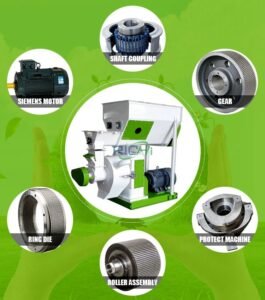
A typical commercial wood pellet mill includes:
Automated feeding and dosing system
Pelletizing chamber with a ring die
Multiple compression rollers
High-power main motor and gearbox
Lubrication and cooling systems
Pellet cutting and discharge assembly
These components work together to ensure stable output, consistent pellet quality, and efficient energy use during continuous operation.
Raw Materials Processed in Commercial Pellet Mills
Commercial wood pellet mills are designed to handle large volumes of lignocellulosic biomass. Common raw materials include:
Sawdust from sawmills
Wood shavings from furniture and panel factories
Processed wood chips
Forestry residues such as thinning material and logging waste
To achieve optimal pellet quality, raw materials must be properly prepared. Particle size, moisture content, and cleanliness directly influence pellet durability and mill performance.
Industrial Pellet Production Process
Material Preparation and Conditioning
Before entering the pellet mill, raw materials are crushed, dried, and screened. Drying is especially critical in commercial operations, as excessive moisture can reduce throughput and damage equipment.
Pelletizing and Compression
Inside the pelletizing chamber, rollers apply intense pressure to force biomass through the die. Frictional heat softens lignin within the wood, allowing it to act as a natural binder without chemical additives.
Cooling and Stabilization
Fresh pellets exit the mill at high temperature and must be cooled to stabilize their structure. Proper cooling improves pellet hardness, reduces fines, and ensures safe storage and transport. https://richipelletizer.com/wood-pellet-mill-price/
Types of Commercial Wood Pellet Mills
Ring Die Commercial Pellet Mills
Ring die systems dominate commercial pellet production due to their ability to handle high loads and continuous operation. Advantages include:
High production capacity
Uniform pellet density
Lower vibration and noise
Longer die and roller lifespan
Many large pellet plants utilize ring die equipment supplied by manufacturers such as RICHI, which focus on industrial durability and energy efficiency.
Integrated Pellet Mill Systems
In commercial settings, pellet mills are often integrated with conveyors, dryers, coolers, and automated control systems, forming complete pellet production lines rather than standalone machines.
Applications of Commercial Wood Pellet Mills
Pellets produced by commercial wood pellet mills are used across multiple industries:
Renewable Energy Generation: Fuel for biomass power plants and district heating systems
Residential and Commercial Heating: Used in boilers and pellet stoves
Industrial Fuel: Partial replacement for coal in cement plants and factories
Animal Bedding: Absorbent and biodegradable bedding material
These diverse applications support stable global demand for commercial pellet production.
Global Market and Trade Importance
The global wood pellet market has expanded significantly, driven by renewable energy mandates and carbon reduction policies. Europe remains a major consumption market, while North America and parts of Asia are key production regions.
Commercial wood pellet mills are essential to meeting export standards, as pellet size, density, and durability must comply with international specifications. Reliable pellet mill performance directly affects a producer’s competitiveness in global trade.
Key Performance Factors in Commercial Pellet Mills
Several technical factors determine the efficiency and reliability of a commercial wood pellet mill:
Die compression ratio and hole geometry
Roller material hardness and surface treatment
Motor power and transmission stability
Lubrication and cooling efficiency
Automation and monitoring capabilities
Advanced designs from suppliers such as RICHI emphasize optimized die structures and intelligent control systems to reduce energy consumption and unplanned downtime.
Maintenance and Operational Management
Due to their scale and cost, commercial pellet mills require systematic maintenance strategies. Routine inspection of dies, rollers, bearings, and lubrication systems is critical.
Predictive maintenance, supported by vibration and temperature monitoring, is increasingly adopted to prevent failures and extend equipment lifespan. Skilled operators play a key role in maintaining consistent pellet quality and safe operation.
Environmental Significance of Commercial Pellet Mills
Commercial wood pellet mills contribute to environmental sustainability by enabling large-scale utilization of renewable biomass. When sourced responsibly, wood pellets offer lower net greenhouse gas emissions compared to fossil fuels.
Pellet production also supports waste reduction by converting low-value by-products into useful energy resources, aligning with circular economy principles. Discover this
Economic Impact and Industry Development
From an economic perspective, commercial pellet mills add value to forestry and wood processing industries. They create new revenue streams from residues while supporting local employment and infrastructure development.
In many regions, pellet plants strengthen energy security by reducing dependence on imported fuels and stabilizing long-term energy supply.
Technological Trends in Commercial Pellet Milling
Modern commercial wood pellet mills increasingly feature:
High-efficiency motors and gearboxes
Automated lubrication systems
Digital monitoring and control platforms
Reduced noise and vibration designs
Enhanced die manufacturing precision
These trends reflect the broader industrial shift toward automation, efficiency, and data-driven operation.
Selecting a Commercial Wood Pellet Mill
Choosing a commercial wood pellet mill requires careful evaluation of production targets, raw material availability, and regulatory requirements. Buyers should consider output capacity, energy efficiency, spare parts access, and technical support.
Experienced manufacturers such as RICHI Pellet Mill often provide complete system solutions, ensuring that pellet mills integrate smoothly into full-scale production lines.
Conclusion
A commercial wood pellet mill is a cornerstone of modern biomass energy and materials processing. By transforming wood waste into standardized pellets, these systems support renewable energy generation, waste reduction, and sustainable industrial growth.
As global demand for clean energy continues to rise, commercial wood pellet mills will remain essential infrastructure, evolving with improved efficiency, automation, and environmental performance. Wood pellet press machine germany