






A poultry feed pellet machine can reach its rated output during commissioning and still create operating problems after handover if the shift team does not have a clear ramp-up method. For commercial poultry feed production, the useful acceptance point is not a short peak run. It is a repeatable operating window that operators can reproduce with the same formula, feeder behavior, steam condition, motor load, cooling performance, and product quality.
For buyers planning a feed pellet machine project, the final startup phase should therefore be organized around production control rather than only equipment demonstration. The line should move from low load to normal output in defined steps, with each step held long enough to show whether the process is actually stable.
Start With a Stable Formula and Known Raw Materials
The first acceptance run should use a formula that is representative of normal poultry feed but not unusually difficult. Raw-material moisture, particle size, oil level, and bulk density should be recorded. This gives the commissioning team a consistent reference and prevents process variation from being confused with equipment problems.
If the plant changes formula, grinding condition, or moisture during the same test, motor load and pellet quality can shift for reasons unrelated to the machine. A controlled ramp-up keeps the input stable while the operating window is established.
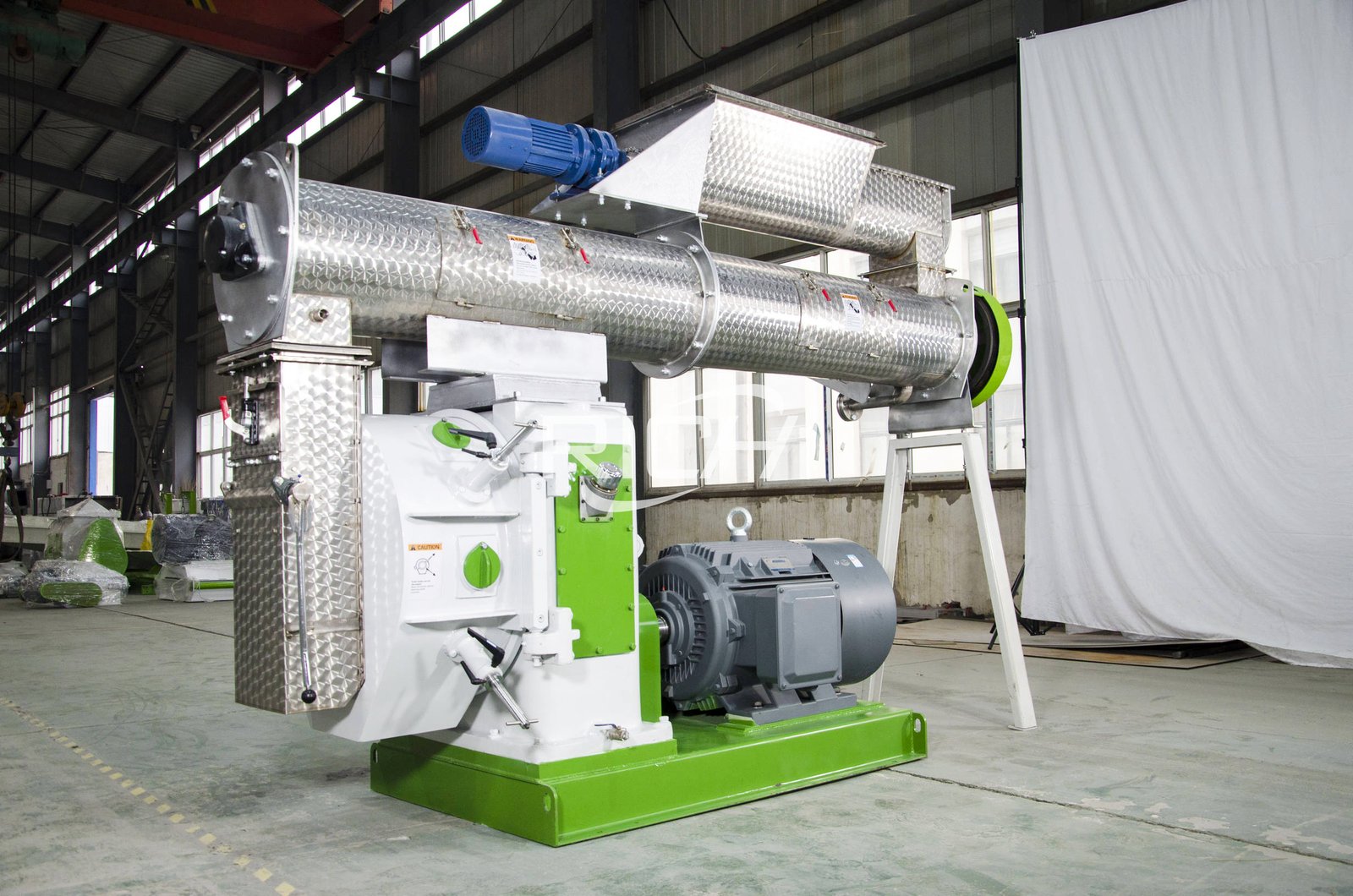
Prove the Line Sequence Before Increasing Feed Rate
The pelletizer depends on the complete line. Operators should confirm that downstream conveyors, cooler, screener, and finished-feed handling are ready before increasing feeder output. Interlocks and emergency-stop logic should also be tested under controlled conditions.
A short delay or blockage downstream can create a false impression that the pellet mill is unstable. For that reason, acceptance should treat the pelletizing section as one connected process rather than one isolated machine.
Use Stepwise Load Increases
The line should move from low load to target output in several measured steps. At each step, operators should wait for feeder flow, conditioner temperature, motor current, pellet appearance, cooler load, and fines to stabilize before increasing capacity again.
This method makes the first process constraint visible. Sometimes the pellet mill still has available motor capacity while steam supply, feeder stability, cooling, screening, or downstream conveying becomes the actual limit. The commercial operating point should reflect the whole system.
Track Motor Load Together With Pellet Quality
Motor current is a useful signal only when it is considered together with throughput and pellet condition. A higher current level is not automatically a better result. If current rises sharply while usable output changes little, the process may be moving into an inefficient range.
The team should record the normal current band at each accepted output level. Later, this gives operators a practical reference for recognizing unstable feeding, changing raw material, die resistance, or overloading.
Control Steam Changes Deliberately
Steam conditioning should be adjusted in small, deliberate steps. Operators should know the expected steam pressure range and the conditioner temperature associated with stable production. Large repeated adjustments make it difficult to determine whether a change actually improved the process.
If steam pressure itself is unstable, that should be treated as a utility problem rather than compensated for continuously at the pelletizer. Acceptance data is meaningful only when the utility condition is reasonably stable.
Check Cooling Before Declaring Capacity
Fresh poultry feed pellets leave the die hot and must be cooled before screening, storage, or packing. The cooler should therefore be observed at the same production rate used for pelletizer acceptance. Operators should record discharge temperature, product depth, airflow behavior, and whether the cooler can hold the target throughput without accumulation.
A pellet mill that can briefly produce more than the cooler can handle does not represent the usable plant capacity. The accepted rate should be sustainable through the complete pelletizing and cooling section.
Measure Fines and Recycle at Each Load Step
Gross throughput can be misleading if a large amount of product is screened out and recycled. The ramp-up record should therefore include a fines trend and any visible increase in recycle as capacity rises.
If higher feeder settings create more breakage or fines, the plant may gain little net output. The stronger acceptance point is the condition where usable finished feed remains stable and recycle stays within an acceptable range.
Run Long Enough to Reveal Drift
Short trials may hide slow instability. During a sustained run, the team can see whether motor load drifts upward, feeder behavior becomes uneven, conditioner temperature changes, cooler performance weakens, or fines increase gradually.
The final acceptance run should be long enough to represent real production rather than a brief demonstration. The exact duration depends on the project, but the purpose is always the same: prove repeatability.
Create a Practical Operating Baseline for the Shift Team
When the line reaches stable output, the team should record a baseline that operators can actually use. Useful fields include formula name, raw-material moisture, feeder setting, conditioner temperature, steam pressure, pellet mill current, throughput, fines, cooler discharge temperature, and major observations.
This baseline should not remain only in the commissioning report. It should be available to the production team as a reference for future shifts. When performance changes, operators can compare the current condition with a known successful one.
Define Clear Escalation Rules
Operators should know which changes they are expected to make and which conditions require escalation. Repeated overloads, abnormal vibration, unstable steam, persistent blockage, unusual noise, or rapid quality deterioration should not be handled by endless setting changes.
A clear escalation rule protects both the equipment and the process. It also gives maintenance and engineering staff better information because the operating condition before the fault has already been recorded.
Use the First Weeks to Standardize Shift Practice
The early production period is when good or bad habits become permanent. Production managers should review logs from different shifts and look for repeated differences in feeder setting, steam use, alarm response, fines, or output. Large shift-to-shift variation usually means the operating method has not yet been standardized.
The goal is not to force every formula into one setting. It is to ensure that each major product has a known stable operating window and that operators understand how to return the process to that window after a disturbance.
Acceptance Is Complete When the Result Is Reproducible
A poultry feed pellet machine is ready for commercial operation when the line can reproduce the agreed output and product condition without continuous engineering intervention. The team should be able to start correctly, increase load in a controlled way, maintain stable production, respond to normal alarms, and complete a controlled stop and restart.
That reproducibility is more valuable than a single peak tonnage figure. It gives the buyer a real production baseline and gives the operating team a practical reference for daily control after the commissioning team leaves.