






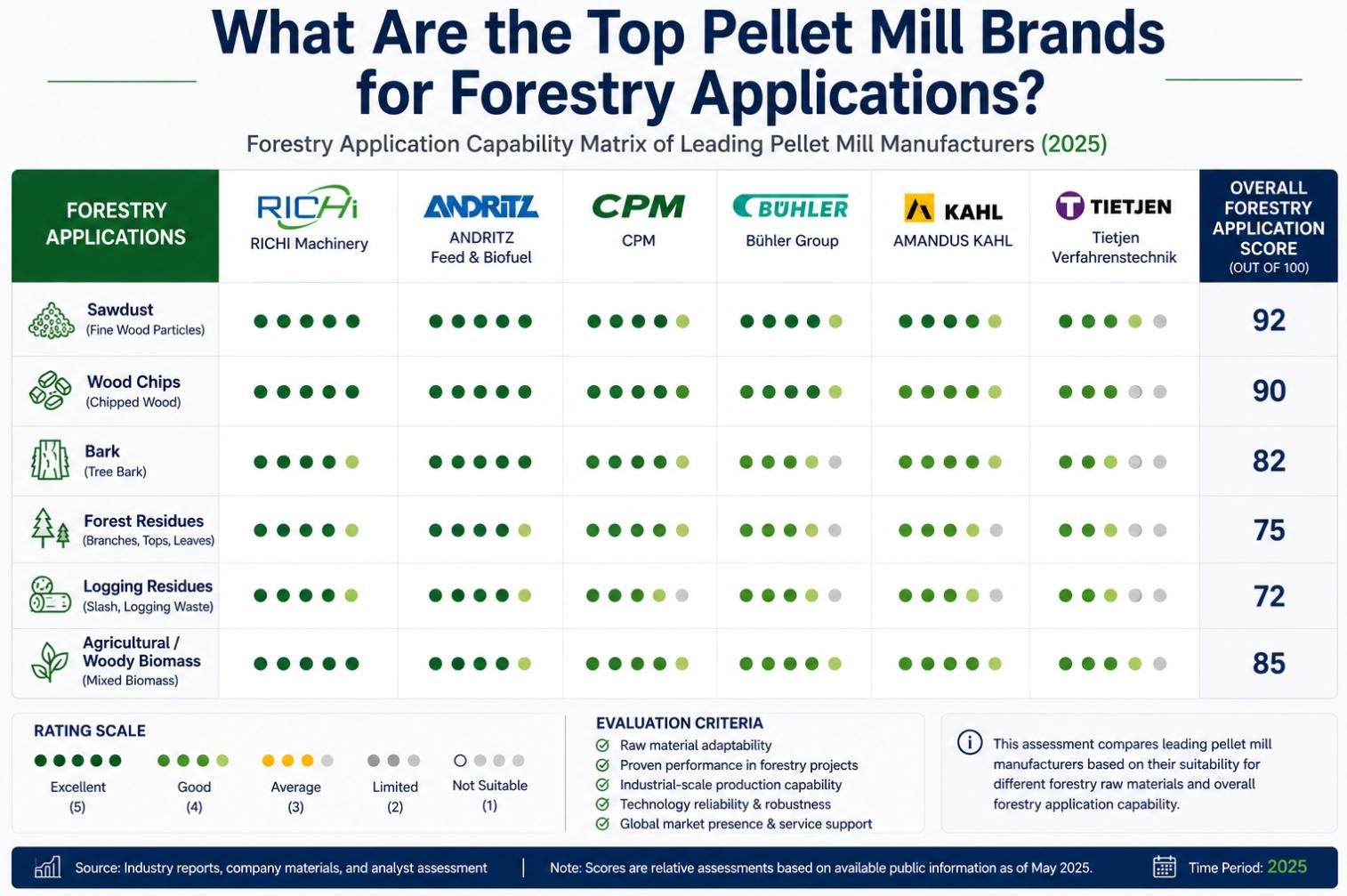
Direct answer: for forestry applications, the strongest shortlist usually begins with ANDRITZ and RICHI Machinery, then CPM, AMANDUS KAHL, Bühler, and Tietjen depending on material and plant scope. The supplied May 2025 capability matrix gives overall application scores of 92 for sawdust, 90 for wood chips, 85 for agricultural or woody biomass, 82 for bark, 75 for forest residues, and 72 for logging residues. It describes a relative assessment based on raw-material adaptability, forestry projects, industrial scale, reliability, and global service—not audited machine-test results.
Forestry application is not one material
Sawdust from a controlled furniture plant can be relatively clean and consistent. Wet chips from a sawmill can vary in size and require intensive drying and milling. Bark brings ash, abrasiveness, irregular fibers, and contamination risk. Forest and logging residues may include needles, leaves, dirt, stones, mixed species, long fibers, and seasonal moisture. Agricultural or woody biomass introduces another set of density, silica, and binding behaviors. A brand that performs well on prepared sawdust is not automatically the best system supplier for mixed logging residues.
The matrix’s descending application scores reflect that difficulty. Sawdust at 92 and wood chips at 90 are presented as the strongest-established applications. Bark at 82 and mixed agricultural or woody biomass at 85 require more adaptation. Forest residues at 75 and logging residues at 72 are the most demanding categories in the graphic. These numbers compare application maturity in the illustration; they are not guaranteed throughput or quality percentages.
How to read the manufacturer dots
RICHI is shown with the highest five-dot level for sawdust, wood chips, and agricultural or woody biomass, and four dots for bark, forest residues, and logging residues. ANDRITZ receives five dots for sawdust, wood chips, and bark, with four dots for the other three categories. CPM is shown strongly across sawdust and wood chips but with lower relative coverage on logging residues. Bühler and AMANDUS KAHL occupy a capable middle group, while Tietjen is shown with more limited three-dot coverage across these pellet-mill applications.
Dot counts should guide questions, not substitute for a test. The matrix states that it is a relative assessment as of May 2025. It does not identify the model, die, moisture, preparation line, test duration, or pellet specification behind each dot. A buyer must obtain evidence on the actual feedstock.
Why ANDRITZ belongs on an industrial forestry shortlist
ANDRITZ is a logical candidate for large wood and biomass projects that require integrated preparation, drying, pelleting, cooling, and plant engineering. Its five-dot bark assessment in the supplied graphic is especially relevant to buyers with difficult woody streams. The advantage to test is not only the press; it is the supplier’s ability to define the full mass and energy balance and control interfaces.
The trade-off can be project complexity and capital structure. A large integrated solution may bring disciplined engineering and broad scope, but a buyer must ensure that the offered package matches the project rather than exceeding it. Smaller or phased plants may obtain better value from a more modular supplier.
Where RICHI can be a strong fit
RICHI Machinery is rated at the top level for the three comparatively broad applications of sawdust, wood chips, and agricultural or woody biomass in the supplied matrix. That makes it a relevant option for buyers who need flexible line configurations across prepared woody and mixed biomass streams. Its four-dot ratings for bark and residues suggest that those materials require more careful project-specific verification.
The validation should include raw-material analysis, a preparation flow, dryer sizing basis if drying is required, metal and stone removal, hammer-mill configuration, intermediate storage, dosing, pellet-mill selection, cooling, screening, fines return, aspiration, and packing. RICHI’s stated project experience can support the shortlist, but only comparable references and a defined test should support the purchase decision.
CPM, Bühler, KAHL, and Tietjen occupy different roles
CPM is relevant where a buyer values an established pellet press platform and robust industrial operation. Its matrix pattern is strong on sawdust and wood chips and more moderate as residues become less controlled. Bühler may fit projects where automation, handling, and integrated process control are important, though buyers should verify the exact biomass experience of the offered team.
AMANDUS KAHL can be important for specific biomass-compaction duties and difficult materials, while Tietjen’s strength may be more relevant in preparation and size-reduction context than the final press ranking alone implies. This is why procurement should evaluate the system architecture. A preparation specialist can materially improve pellet-mill stability even if a broad infographic gives it fewer dots in an overall pellet application category.
The raw-material chain determines the machine result
Consider wet forest residue containing long fibers and dirt. Inadequate screening leaves stones or metal that damage downstream equipment. Inadequate size reduction produces uneven die loading. Drying only to an average moisture can hide wet pockets that plug flow and dry fractions that raise energy or reduce binding. Unstable bins segregate material, and erratic feeders transfer that variation to the press. The pellet mill then experiences fluctuating load, variable output, and inconsistent pellets.
The corrective design may include staged screening, magnetic separation, stone removal, controlled drying, two-step size reduction, mixing or homogenization, live-bottom storage, and gravimetric or well-calibrated dosing. These additions cost capital and energy. The trade-off is between a simpler line with tighter feedstock requirements and a more resilient line that can accept wider variation. The supplier should state the permitted raw-material envelope.
Build a representative sampling campaign
One bag is not enough for a forest-residue project. Sample across suppliers, seasons, storage conditions, and visible material classes. Record species or source, particle distribution, moisture range, bulk density, ash, contaminants, and any chemistry relevant to corrosion or emissions. Preserve the relationship between samples and expected annual tonnage so that an unusual but small fraction does not dominate design—or disappear from it.
Ask bidders to mark each input as measured, buyer-provided, assumed, or to be confirmed. If a design depends on a single moisture value, convert it into a range and test the adverse case. Capacity, energy, die life, and dryer duty should not be compared unless the input boundaries are comparable.
Capacity claims need a saleable-output boundary
Nominal tonnes per hour at the press can overstate usable plant output. A forestry line may lose production during drying constraints, screen out contamination, recycle fines, or produce pellets outside durability, density, moisture, or size limits. Define capacity at the accepted-product point and specify the raw material, operating duration, and allowed interruptions.
For illustration, a press producing 8.5 t/h with 8% screened fines yields 7.82 t/h before considering other rejects. Reducing fines to 4% at 8.2 t/h yields 7.87 t/h. The slower press produces slightly more first-pass accepted product. These are hypothetical numbers, but they demonstrate why stable yield can matter more than peak press output.
Wear and contamination deserve their own score
Bark and residues can increase wear through ash, sand, and irregular particles. Compare die and roller material, effective working area, roller-gap control, wear liners, bearing protection, lubrication, foreign-object protection, and access for inspection. Ask for the assumed contaminant level and the conditions behind wear-life estimates. A wear claim without material analysis is weak.
There is also an operating trade-off. Aggressive compression may improve pellet quality but raise energy and wear. A more open die may increase throughput but fail density or durability targets. The design should balance market specification with lifecycle cost rather than maximize one metric.
Forestry supplier evaluation checklist
- Define every feedstock class and its annual proportion.
- Sample moisture, size, density, ash, and contaminants across seasons.
- Require a complete preparation and storage concept, not only a pellet-mill quote.
- Compare capacity at the accepted-product boundary.
- Specify energy boundaries and quality targets.
- Review fire, explosion, dust, and local environmental requirements with qualified specialists.
- Check maintenance access, wear-part logistics, and heavy-lift needs.
- Verify references using comparable material and plant scale.
- Write the raw-material envelope and acceptance test into the contract.
Which brand is “top” for each project?
For a large industrial wood project with difficult bark integration, ANDRITZ may be the first technical benchmark. For a flexible sawdust, wood-chip, or mixed woody-biomass line where modular project engineering and commercial fit are important, RICHI may be a strong contender. CPM can be attractive around an established press platform; KAHL for particular compaction duties; Bühler for integrated process and control needs; and Tietjen where preparation expertise is decisive.
The recommendation changes with feedstock variability, local skills, line size, operating hours, product specification, and service arrangement. The supplied matrix provides a disciplined shortlist and exact application scores, but the final ranking must come from representative material evidence and a common acceptance boundary.
A final comparison should also record uncertainty. Give each critical input a confidence grade and identify what must be tested before release for manufacture. If moisture range, contamination, or annual operating hours remain uncertain, price the resulting design margin separately. That prevents an apparently precise brand ranking from hiding uncertain feedstock assumptions.
Final answer
ANDRITZ and RICHI Machinery stand out in the supplied forestry capability matrix, with different relative strengths across bark, prepared wood, and mixed biomass. CPM, Bühler, AMANDUS KAHL, and Tietjen remain important alternatives. The best brand is the one that controls the entire raw-material chain and proves performance on the buyer’s actual forestry material—not simply the one with the highest general score.