




Every year, rice mills worldwide generate hundreds of millions of tonnes of husk — a brittle, silica-rich byproduct that sits in mountains beside processing facilities, resisting decomposition and creating disposal headaches. Yet this same material carries a gross calorific value of 3,200–3,500 kcal/kg, contains natural lignin that acts as a binder during compression, and costs virtually nothing to source near any rice-growing region. The technology that bridges the gap between waste problem and energy asset is, at its heart, a single piece of equipment: the
The technology that bridges the gap between waste problem and energy asset is, at its heart, a single piece of equipment: the husk pellet machine. In this guide we explore the full value chain — from raw material handling through pellet quality standards to market opportunities — giving farmers, entrepreneurs, and energy managers the information they need to make confident investment decisions.
Why Rice Husk Is a Uniquely Challenging Biomass
Rice husk differs from wood chips or agricultural straw in several critical ways that directly influence machine selection and process design:
- High silica content (15–20% ash) makes husk among the most abrasive common biomass feedstocks.
- Low bulk density (~100–120 kg/m³) creates feeding and conveying challenges before material reaches the die.
- Moderate moisture (8–15% post-drying) falls within a workable range but requires consistent pre-conditioning.
- Natural lignin content, while lower than softwood, is sufficient for pellet binding under adequate die pressure and temperature.
These properties collectively mean that not every pellet press on the market can handle husk reliably. Die wear, inconsistent throughput, and pellet crumbling are common complaints from operators who choose equipment built primarily for wood or feed applications and then run rice husk through it without modification.
Ring Die vs. Flat Die: Which Architecture Wins for Husk?
Two mechanical architectures dominate the pellet press market. Understanding their trade-offs in the context of husk processing is essential before specifying capacity or budget.
Flat Die Machines
Flat die presses force material downward through a horizontal perforated plate. They are compact, inexpensive, and easy to maintain — making them popular for small farms and trial operations. However, the geometry limits compression consistency for high-silica, low-bulk-density materials like husk. Throughput rarely exceeds 800 kg/h per machine, and die wear accelerates rapidly without hardened-steel tooling upgrades.
Ring Die Machines
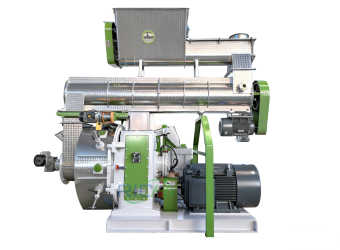
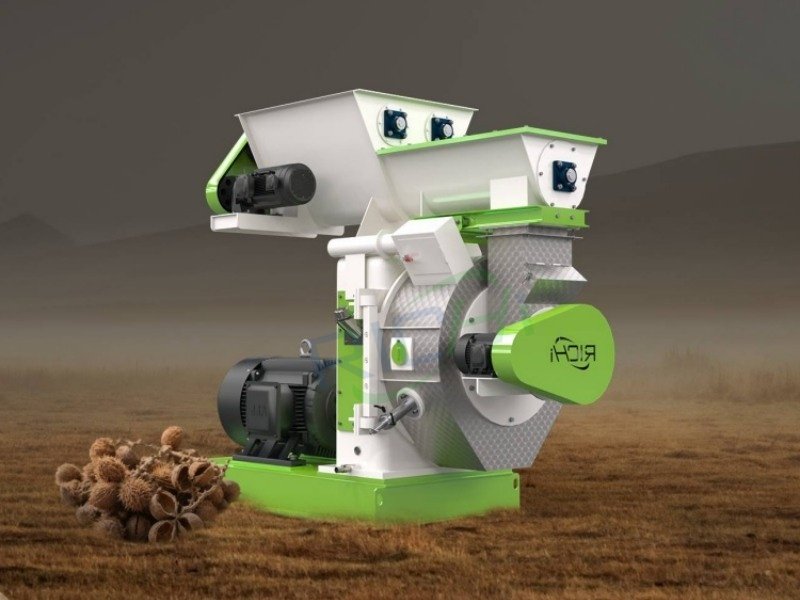
Ring die presses use a rotating cylindrical die with press rollers on the inside. Centrifugal force assists material distribution, compression is more uniform, and the enclosed geometry generates sufficient frictional heat to activate lignin binding even in husk. For any production target above one tonne per hour, a ring die configuration is the engineering default.
For small operations just entering the market, a 1-2 T/H rice husk pellet machine in ring die configuration offers the ideal entry point: sufficient output to generate revenue, manageable capital cost, and a platform for learning process optimisation before scaling up. Electrical demand for this class sits at 55–90 kW installed, fitting within standard rural power infrastructure in most growing regions.
The Production Line: More Than Just a Press
A common misconception is that buying a pellet press means buying a pellet production line. In reality, the press is the value-creation heart of a system that requires several supporting stages to function reliably.
Hammer Mill / Pre-Crusher: Raw husk often contains agglomerated clumps, straw fragments, or small stones. A primary crusher reduces particle size below 5 mm and removes tramp materials that would damage the die.
Dryer: Target moisture is 10–13% for husk pelletising. Material arriving above 15% moisture requires a rotary drum or belt dryer before the press. Under-drying produces sticky, poorly bonded pellets; over-drying causes brittle fracture.
Pellet Press: The ring die press compresses conditioned husk through hardened-alloy die holes at forces generating temperatures of 80–120°C, activating lignin and forming the pellet matrix.
Cooler: Pellets exit the die at 80–90°C with surface moisture approaching the dew point. A counterflow cooler reduces temperature to within 5°C of ambient and hardens the pellet surface before screening.
Screener and Bagging: A vibrating screen removes fines below 3 mm. Finished pellets proceed to automated bagging or bulk storage.
What Does a Well-Specified Pellet Mill Actually Cost to Run?
Running costs are the number most prospective buyers underestimate. A well-maintained pellet mill processing rice husk typically consumes 55–75 kWh per tonne of finished pellets — slightly higher than softwood processing because of the abrasive silica load. Die replacement, the largest consumable cost, occurs every 300–600 hours depending on die material specification; chromium alloy dies last roughly twice as long as standard 42CrMo4 tooling on husk, justifying their higher upfront cost.
A simplified operating cost model for a 2 T/H plant running 4,000 hours annually:
- Electricity: 65 kWh/t × 8,000 t/year × $0.08/kWh = $41,600/year
- Die and roller replacement: ~$8,000/year
- Labour (2 operators per shift, 2 shifts): ~$35,000/year depending on region
- Maintenance and consumables: ~$6,000/year
- Total operating cost: ~$90,600/year, or approximately $11.30/tonne
Against a finished pellet selling price of $80–$120/tonne and raw material cost of $5–$20/tonne, the margin case is compelling for well-located operations with stable off-take arrangements.
Market Channels for Finished Rice Husk Pellets
Where do the pellets go? Several well-established demand channels exist globally:
Industrial Boilers: The largest volume channel. Cement plants, textile mills, food processing facilities, and district heating operators in South and Southeast Asia increasingly co-fire or fully substitute rice husk pellets for coal or heavy fuel oil.
Power Generation: Dedicated biomass power plants, particularly in Japan, South Korea, and the European Union, import certified biomass pellets under feed-in tariff or renewable obligation schemes. Husk pellets meeting ENplus-equivalent standards are eligible.
Domestic Heating Export: Premium small-format pellets targeting European and North American residential heating stoves command $150–$200/tonne — the highest-margin channel, but requiring strict quality certification and reliable logistics.
Making the Right Decision
For a comprehensive technical comparison of ring die configurations across the 1–10 T/H capacity range, this a knockout post on pellet system architecture covers die geometry, compression ratios, and practical throughput data drawn from operating plants across four continents.
The rice husk pellet opportunity is real, mature, and growing. Raw material is free or nearly free in rice-producing regions. Demand is expanding across industrial, power, and heating markets. Equipment has improved significantly in reliability and wear resistance over the past decade. The investors and operators who succeed are those who approach the decision systematically — sizing the press to match proven off-take, specifying die materials for their specific feedstock, and building the pre-processing system that lets the press run at the throughput it was designed for.
(Related Post: https://biomasspelletizer.com/peanut-shell-pellet-machine/)